Restoring the Architectural Integrity of a Spanish-Style Home
Some homes do not need reinvention. They need restoration.
When my clients purchased this Spanish-style home tucked within one of the region’s most established golf course communities, much of its original architectural character had been obscured beneath layers of heavy finishes and design decisions reflective of the late-2000s Tuscan trend.
The bones were still there. But the house had slowly lost connection to the architecture it was originally meant to embody. Our goal was never to modernize it for its own sake. It was to restore clarity, warmth, and architectural cohesion while creating a highly functional lock-and-leave home for clients dividing their time between Tahoe and Granite Bay.


Island was enlarged and shifted to better accommodate multiple cooks
Returning the Home to Its Spanish Roots
Rather than layering in more detail, much of the renovation centered around subtraction.
Heavy crown molding was removed throughout the home in keeping with traditional Spanish architecture. Any new moldings introduced were intentionally restrained, using simpler profiles and robust wood detailing where emphasis was needed.
Arches were incorporated throughout the house to soften transitions and reinforce the architectural language of the home’s original structure.
Materials became quieter, warmer, and more authentic.
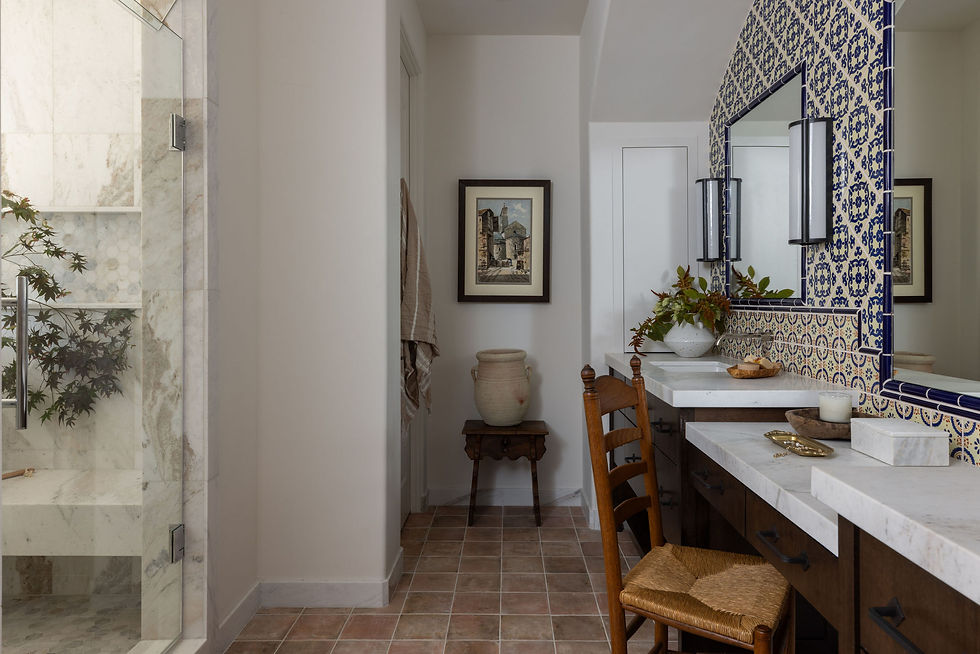
Traditional Saltillo and Spanish-patterned tile were incorporated selectively throughout the home, including the bathrooms, laundry room, entry, courtyard, and exterior spaces. Against an otherwise restrained palette, they brought texture, authenticity, and a sense of playfulness without overwhelming the interiors.
A palette of layered whites, terracottas, rich wood tones, rusts, and saturated blues helped reconnect the home to its Mediterranean roots while still feeling calm and livable. Other traditional elements such as iron were brought in as well; in the kitchen we incorporated gorgeous hand forged iron pulls and (a favorite) iron and glass lantern over the sink.
Designing for the Way They Actually Live
My clients were recent empty-nesters and avid travelers looking for a beautifully appointed home that could function effortlessly as a lock-and-leave property while still accommodating visiting adult children and extended family.
That meant the renovation needed to go beyond aesthetics.
Throughout the house, spaces were reconfigured to improve flow, eliminate wasted square footage, and increase functionality without unnecessarily enlarging rooms.
In the primary bathroom, for example, the footprint was actually reduced. By tightening the layout and removing underutilized space, we were able to create a larger steam shower while simultaneously increasing storage and closet functionality elsewhere.
Concealed storage was integrated throughout the home, including flush side cabinet doors carefully incorporated into the arched vanity wall to maintain visual continuity without sacrificing practicality.
The result is a house that feels expansive without excess and functional without feeling utilitarian.

Editing Visual Weight
One of the most transformative moments in the home occurred in the living room.
The original media cabinetry felt visually heavy and disconnected from the architecture itself. Rather than adding more ornamentation, we simplified the space dramatically by removing the outdated built-ins and replacing them with a more appropriately suited architectural media wall complete with open shelving and concealed lower storage.
The new design allows texture, proportion, and collected pieces to carry the visual interest rather than excessive detailing.
The fireplace itself was also reworked. It was originally hidden deep in the corner and didn't feel like it was part of the room. We kept the same angle but brought it forward into the room to better fit the layout, and simplified it to better suit the home’s Spanish character, making it less of a focal object and more integrated into the room's architecture.

Living room before; the fireplace seemed like an afterthought, shoved deep into the corner

A Courtyard Designed to Be Lived In
The courtyard renovation became another exercise in editing and intentionality.
An awkward kidney-shaped plunge pool was removed entirely in favor of creating a more usable outdoor living space centered around entertaining, ease of maintenance, and year-round indoor-outdoor living.
In its place, a 50-year-old olive tree was carefully craned into the courtyard, grounding the space with the permanence and quiet character the home had been missing.
Low-maintenance plantings, layered hardscape, and integrated gathering areas transformed the courtyard into an extension of the home itself rather than an afterthought.


The table sits right in the center of where the plunge pool was
The Power of Alignment
The goal of a renovation is for the home to not feel like a renovation, but to feel as though the home simply settled into itself.
By the end of the project, the transformation was significant, but spectacle was never the intention. It was alignment. Allowing the interiors, architecture, and the way my clients live to finally come together in one cohesive piece.
Recently sold off market following significant buyer interest, the home became a reminder that thoughtful design does not simply transform how a home looks, but how it is perceived in ways that is difficult to put words around but nevertheless makes sense as it's being experienced.
Interested in more design insights? Read our post about kitchen renovations here, our favorite paint colors for spring, and what design features we're seeing in luxury bathrooms today.

Lisa
Let's Make Something Beautiful