
How to Think About Lighting in Layers (and Why Many Homes Get It Wrong)

Lighting is one of the fastest ways to change how a space feels, yet it is often treated as a finishing touch.
I have recently had more clients express the need for better lighting, but there is still a gap between recognizing that and understanding how to actually fix it.
Most homes still rely on a single overhead fixture to do most of the heavy lifting. It turns on, it lights the room, and technically, it works.
But a room can be fully illuminated and still feel visually unresolved.
One of the biggest mistakes I see in otherwise beautiful homes is lighting being treated as an afterthought rather than part of the architecture itself.
And this is key: by the time most people start thinking seriously about lighting, the opportunity to do it exceptionally well has already narrowed.

The Shift: Lighting as a System
Good lighting is not about choosing the “right” bulb or fixture, though both matter.
It is about understanding that different activities within a room require different kinds of light.
Most well-designed spaces rely on a combination of:
General illumination
Functional lighting
Focal or atmospheric lighting
The mistake is usually not a lack of fixtures. It is expecting one source of light to do every job well.
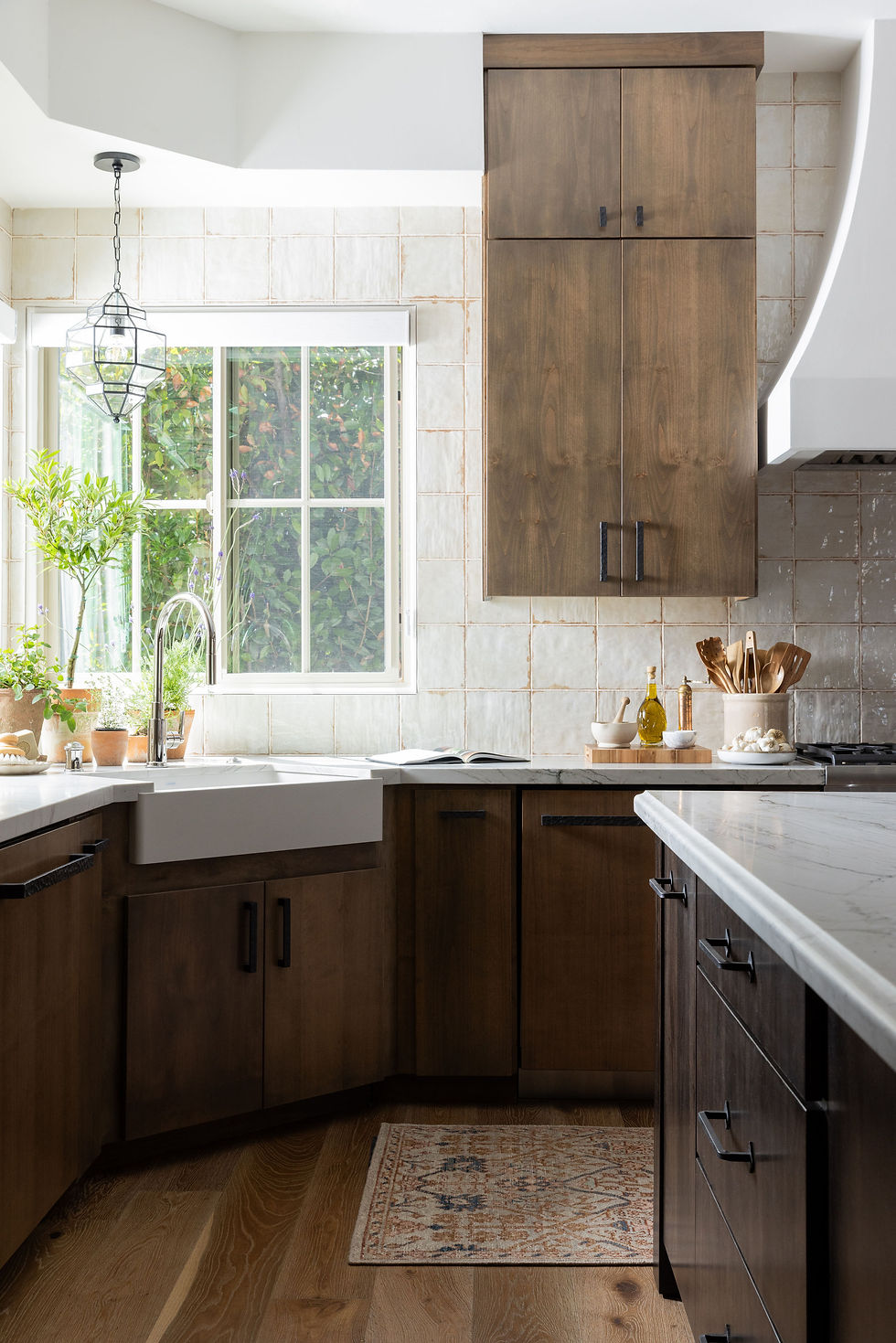
A kitchen, for example, needs:
Visibility for prep work
Softer lighting for evenings
Focused lighting where attention should naturally land
Those are entirely different requirements, yet most homes ask a single overhead fixture to handle all of them.
That is usually where things begin to break down.

Why Some Homes Feel Better Than Others
Well-designed spaces understand restraint.
When everything is equally bright:
There is no hierarchy
No focal point
No sense of atmosphere
Some areas should intentionally recede while others become more prominent.
This is one reason hospitality spaces often feel so much more inviting than residential spaces. Restaurants, boutique hotels, and cocktail bars rarely flood every corner with light. They use reflection, shadow, and contrast to shape how the room is experienced.
Residential spaces obviously need to function differently, but the same principles still apply. Luxury spaces are rarely the brightest spaces.

The Most Common Lighting Mistakes
Relying too heavily on recessed lighting:
Recessed lighting absolutely has its place, but when it becomes the only source of illumination in a room, spaces tend to feel overly exposed and one-dimensional. A ceiling full of recessed cans does not automatically equal a well-lit room.
Putting everything on one switch:
When every fixture turns on at full brightness simultaneously, there is very little flexibility in how the room functions. This is where dimmers, zoning, and automation become valuable. Not because they are flashy, but because they allow a space to adapt throughout the day.
Treating under-cabinet lighting like an afterthought:
This is one of the most common mistakes I see in kitchens. Undercabinet lighting is one of the hardest-working layers in the room. It dramatically improves functionality, but when done correctly, it also changes the kitchen's atmosphere entirely.
The challenge is that by the time lighting decisions are finalized, many projects are already experiencing budget fatigue. So this layer often gets downgraded or rushed. And it shows. Visible LED dots reflecting across a polished countertop immediately cheapen the effect. Good undercabinet lighting should feel seamless. You should perceive the illumination itself, not the mechanics creating it. This is also where dimmers matter enormously. Task lighting calibrated for cooking at 6 am should not feel the same as lighting during dinner or entertaining later in the evening. It is a relatively small detail that makes a surprisingly large difference.

The Real Upgrade: Control
The shift happening in lighting is less about fixtures themselves and more about precision.
Not simply whether lights turn on, but:
How bright they are
Where they are isolated
How they transition throughout the day
And how different layers interact with one another
This is where dimmers, zoning, and programmable scenes become valuable. Not because they are novel.
Because they allow a home to respond differently at different times of day. Morning should feel different than evening. Entertaining should feel different than cleaning the kitchen after dinner. This is what smart lighting actually means. Not novelty, but control over how a home functions and how it is experienced. Many newer systems now allow light temperature and intensity to shift automatically in ways that more closely mimic natural daylight patterns. At the highest level, these systems become nearly invisible in use.

What This Looks Like at the Highest Level
At the far end of this spectrum, lighting becomes fully integrated into the design of a home itself. High-end lighting designers like Nathan Orsman create environments where light is programmed from the outset, shifting color, intensity, and layering automatically throughout the day. Each room responds differently. And once it is set, it fades into the background. No constant switching. No ongoing adjustments. What matters here is not necessarily the level of technology. It is the timing. Lighting like this is planned early, alongside architecture, millwork, and layout. Because the most impactful lighting is rarely decorative alone. It is built in. And when it is thoughtfully planned from the beginning, architectural decisions can be made to support it properly.
Bringing It Into Real Homes
Most homes do not need that level of integration to see a meaningful difference. What is changing more broadly is access to control. Higher-end systems like Lutron allow for whole-home scenes and seamless integration. More accessible options bring many of the same concepts into smaller-scale projects.
The specifics matter less than the larger shift:
Away from static lighting
Toward adaptable environments
Toward designing how a home functions throughout the day

Color Temperature- What Is That All About? And How It Fits In
Color temperature matters, but only in context.
2700K to 3000K: warm and residential
3500K to 3700K: balanced and natural
4000K and above: cooler and more clinical

One of the most common mistakes is mixing incompatible color temperatures throughout a home. A cool white recessed light next to a warm decorative lamp can subtly distort wall color, materials, and even skin tones without people fully understanding why the room feels slightly off.
The goal is not to use one “perfect” temperature everywhere. It is alignment between:
The function of the room
The natural light available
The materials within the space
And how the room is primarily used
The Takeaway
Most homes- especially custom- are technically well-lit. That is not the same thing as being thoughtfully lit.
The difference usually comes down to:
Restraint
Calibration
Sequencing
Understanding how a space is meant to function throughout the day
Because good lighting is rarely about the fixture itself. It is about shaping how a home is experienced, which is what it is ultimately all about.
Looking for more? Read our post about glass and metal light fixtures here. Or check out our post on design trends that are defining 2026 for more design tips!

Lisa
Let's Make Something Beautiful


